
Forensic Surveillance Versus Proactive Security
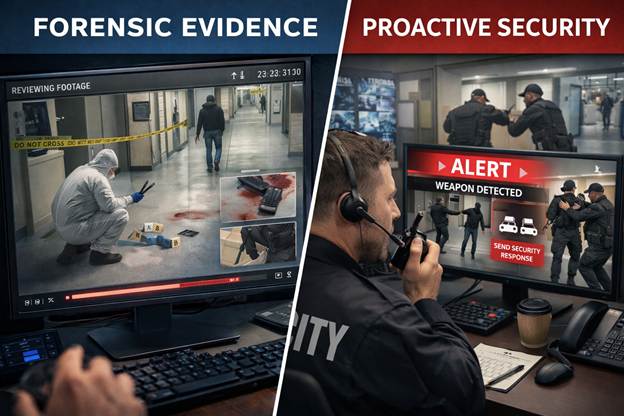
The difference between a record-only IP camera system and a real-time alerting (AI-enhanced) system is essentially the difference between forensic security and proactive security. Each has benefits, but they serve very different operational objectives.
This article compares recorded security video to a system that uses an alert-type AI-enhanced Security.
Record-Only IP Camera Systems (Reactive Security)
These systems continuously record video for later review.

Benefits:
- They provide evidence and documentation of an incident, so they are useful for investigation, liability claims, and compliance. They can help law enforcement and help with insurance cases.
- These provide the traditional security benefits with lower Cost and Simpler Design.
- They don’t cause false alarms. They just provide a later analysis of situations that a person can interpret.
- No security guards are required to maintain the security system, making the total system cost less than an active alert system that requires human intervention.
Limitations
- Incidents are discovered after they occur
- No ability to prevent or interrupt events
- Requires manual review of large amounts of video
Real-Time Alerting Systems (AI-Enhanced, Proactive Security)
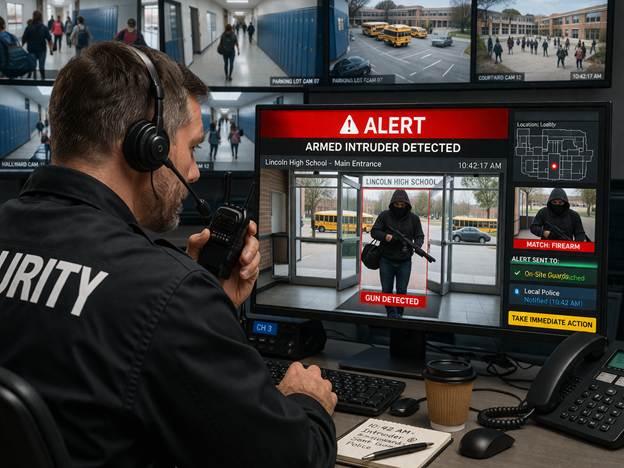
These systems analyze video (and sometimes audio) in real time and notify security when a threat is detected.
Benefits
These AI-enhanced Surveillance Systems provide immediate threat detection by immediately identifying dangerous situations as they happen. They can detect intrusions, weapons, and abnormal behavior, and people entering restricted areas.
The result is providing intervention during the event, resulting in less theft, vandalism, workplace incidents, and safety risks.
This security system provides Prevention, Not Just Documentation. It allows the organization to dispatch security guards, issue audio warnings, lock doors, or contact authorities.
Critical Advantage: Verified Alerts
When combined with human remote monitoring, these systems:
- Review AI-generated alerts in real time
- Confirm whether a threat is legitimate
- Notify the organization only when there is a verified risk
This dramatically reduces false alarms while maintaining fast response.
Key Comparison
| Feature | Record-Only | Real-Time Alerting |
| Primary Role | Evidence | Prevention |
| Response Time | After event | During event |
| Human Monitoring | Manual review | Event-driven |
| False Alarms | None | Reduced with AI + verification |
| Cost | Lower | Higher (but higher value) |
| Security Level | Reactive | Proactive |
When to Use Each
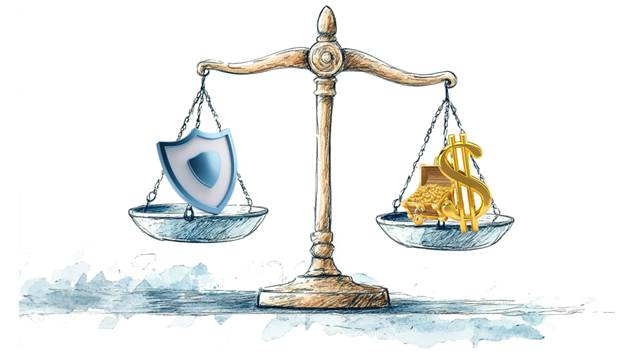
Record-Only Systems Are Best When:
- Budget is limited
- Primary goal is documentation
- Low-risk environments
- Compliance or auditing is required
Real-Time Alerting Systems Are Best When:
- Safety is critical (schools, healthcare, public spaces)
- High-value assets are involved
- Rapid response is required
- Organizations want risk reduction, not just evidence
Final Thought
A record-only system answers the question:
“What happened?”
An AI-enabled, real-time system answers:
“What is happening right now and what should we do about it?”
That shift from observation to action is what fundamentally changes how surveillance protects an organization.
If you need help determining the best surveillance system for your organization, please get in touch with us at 914-944-3425, email dennis@kintronics.com, or use our contact form.