How to determine the resolution required for your IP camera system By Bob Mesnik
How much resolution do you need? It depends on what you need to see. Do you want to identify who stole your car, or just see that there’s a dog in your yard again.
It’s very important to first determine exactly what you want to see, because it will affect how much your IP camera system costs.
This article reviews the amount of resolution required to recognize objects such as people, vehicles, license plates, or even a small crack in a wall.
This article has been updated on 10/4/2018 to reflect the new PoE injectors available.
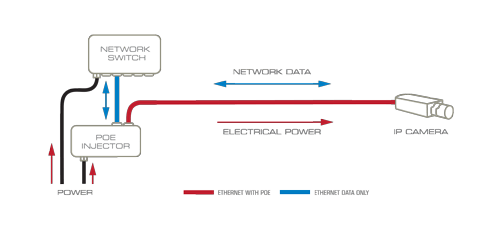
Many network-attached devices, such as IP cameras, VoIP phones, WiFi radios, and IP door readers use power over Ethernet (PoE). The single network cable transfers both data and power to the device making installation very simple. The data uses one set of wires, while the power uses another set of wires in the network cable.
Do not walk behind me, for I may not lead. Do not walk ahead of me, for I may not follow. Do not walk beside me either. Just pretty much leave me the hell alone.
Optical Archiving Libraries make it easy to protect your data. by Bob Mesnik
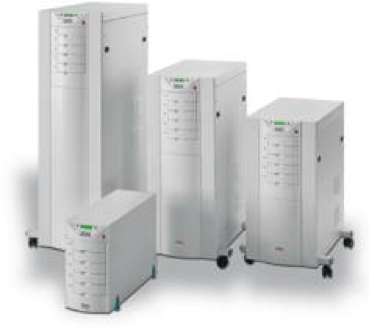
So you are being dragged kicking and screaming to archive your e-mails and data. What can you do that doesn’t cost an arm and a leg? Well, the new jukebox library systems with the latest 100 GB media are now an economical alternative to tape, and provide the best way to archive your data.
The library software makes the jukeboxes easy to use so you can archive your data quickly and automatically. Blu-ray media is now the same price per megabyte as the tape media, and provides archive quality that’s not available with tape.
So you are being dragged kicking and screaming to archive your e-mails and data. What can you do that doesn’t cost an arm and a leg? Well, the new jukebox library systems with the latest 100 GB media are now an economical alternative to tape, and provide the best way to archive your data.
The library software makes the jukeboxes easy to use so you can archive your data quickly and automatically. Blu-ray media is now the same price per megabyte as the tape media, and provides archive quality that’s not available with tape.
The technology for storing data continues to bring us ever-increasing capacity. First, there were CD-ROM discs, next the DVD-discs, which increased capacity and data transfer speed. Now we have blu-ray discs that provide 100 GB of storage. They are used in optical jukeboxes or libraries for archiving computer data
Blu-ray Discs (BD) was introduced by Sony in October 2000. Even though this new technology was developed for the consumer market, it also was capable of handling computer data. As a matter of fact, Blu-ray became the standard in both markets.
Meeting the requirements of the Sarbanes-Oxley Act
As I recall, the first optical discs became available in the fall of 1984. I was working for Sony at the time, and one of the engineers from Japan visited our office in New Jersey. “Bob”, he said, “Do you want to sell WORM in the US?” I looked at him kind of funny and said, “We don’t eat worms in this country”. “Oh no Bob-san, not worms, Write Once Read Many – W, O, R, M. This is optical disc”. This was my first introduction to optical storage. The technology has improved dramatically over the years and the market for the product has grown. Today optical disc systems are starting to replace tape libraries. The cost per megabyte is about the same, but optical storage is archival while tape is not.
As I recall, the first optical discs became available in the fall of 1984. I was working for Sony at the time, and one of the engineers from Japan visited our office in New Jersey. “Bob”, he said, “Do you want to sell WORM in the US?” I looked at him kind of funny and said, “We don’t eat worms in this country”. “Oh no Bob-san, not worms, Write Once Read Many – W, O, R, M. This is optical disc”. This was my first introduction to optical storage. The technology has improved dramatically over the years and the market for the product has grown. Today optical disc systems are starting to replace tape libraries. The cost per megabyte is about the same, but optical storage is archival while tape is not.
There are many reasons to archive corporate and government information. For example, the Sarbanes-Oxley Act of 2002 defines regulations for saving information. Here is a summary of some of the reasons for using optical jukeboxes to meet these requirements:
This article compares central analog amplifiers to distributed digital network attached amplifiers.
The latest IP paging systems utilize the Ethernet network to distribute sound over your organization. This is quite different than the classic systems that used a large central amplifier with wires to all the speakers. How good is this new approach to paging?
The following article compares the traditional approach that utilizes one large amplifier to the latest PA over IP systems.
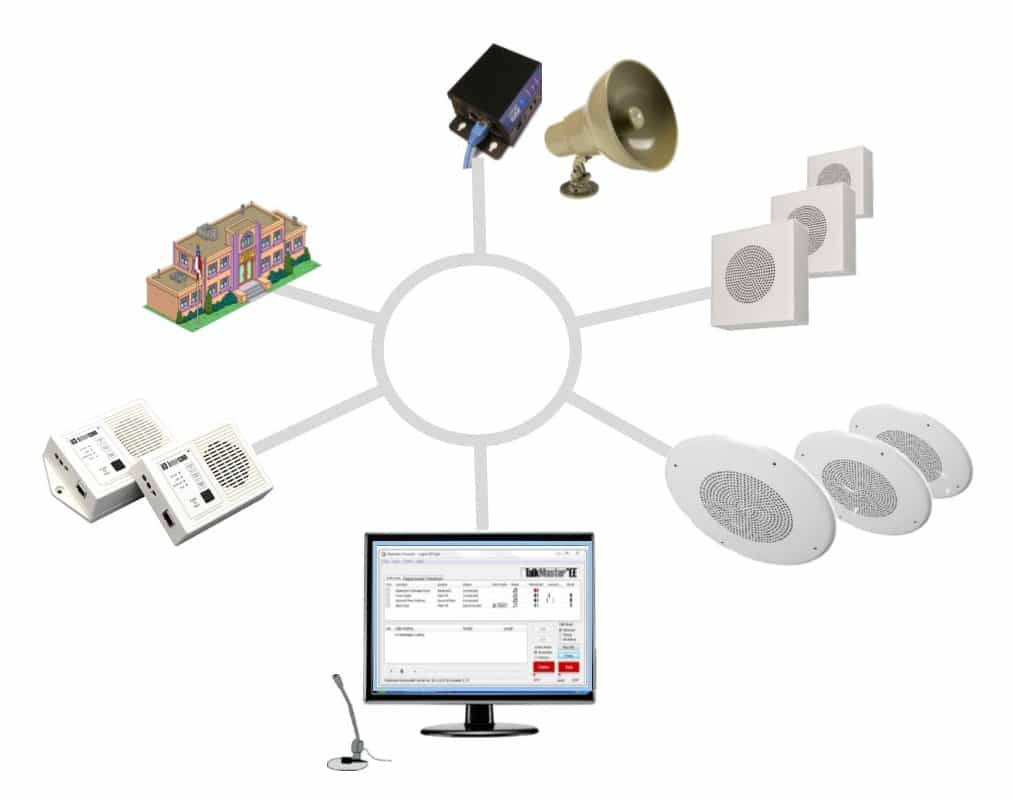
The classic method of providing a paging system was to connect many speakers to a central very large amplifier. The latest IP amplifier method is much more flexible. It connects a few speakers to many small network attached amplifiers that are distributed around the organization. You can attach several speakers to one small IP amplifier or attach one CAT5 ready IP speaker directly to the network. Here’s a comparison the two types of systems.
How the University of Montana College of Forestry uses the IP camera systemby Virginia Fair
When a customer calls Kintronics seeking information about IP cameras, our sales engineers ask questions such as “What are your objectives? What do you want to monitor?” And “In what type of environment will you be mounting the camera?”
They are accustomed to hearing answers like parking areas, corridors, storerooms, entry areas, rear exits, elevators and so on. But every once in a while, the answer is unique and intriguing.