Review of the methods for integrating IP Camera systems with IP door access or digital point of sale systems
By Bob Mesnik
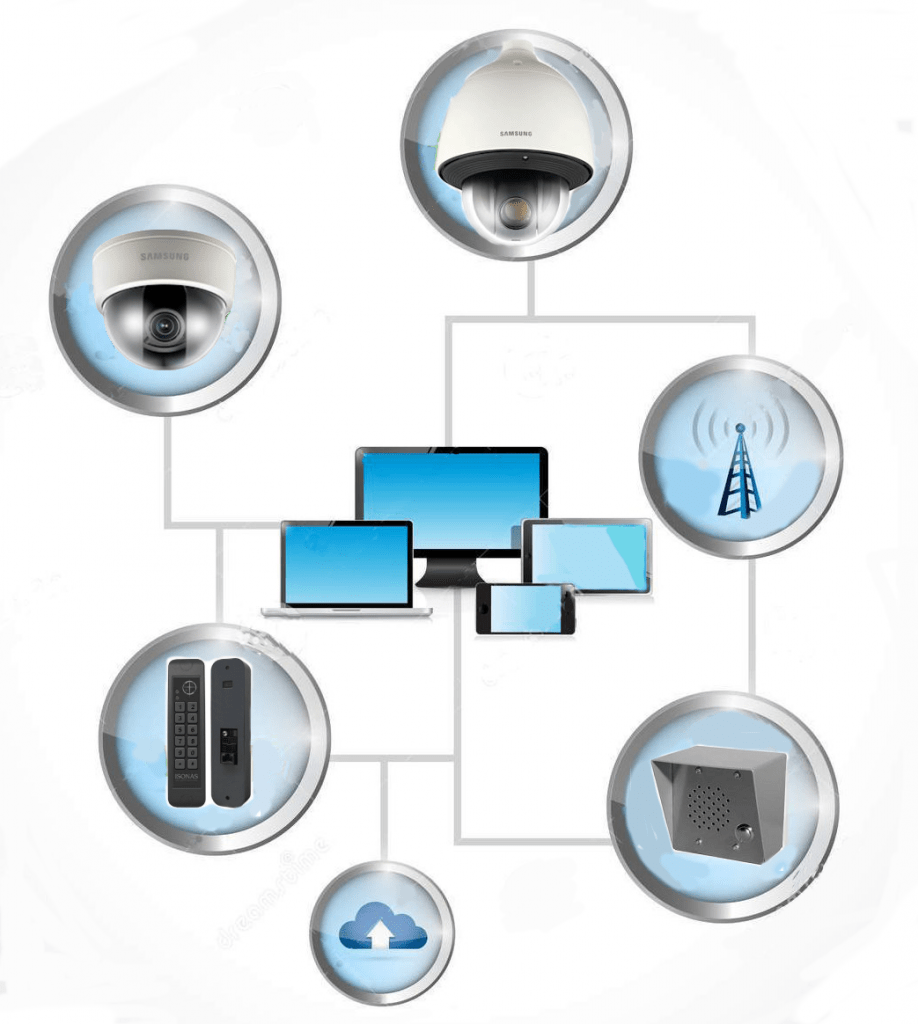
C2P Convergence Concept
What’s next for Video Recording Systems? IP Camera manufacturers and third party companies such as OnSSI, Milestone, Axis, Exacq, and others have been providing software and NVR recording systems for many years. All these systems provide basic video recording functionality. How can the functionality and value of these recording systems be increased?
We reviewed a number of different systems and found that the next generation of video management systems (VMS) is already here.
“If God had written the Bible, the first line should have been ‘It’s round.'” – Eddie Izzard
“A hotel minibar allows you to see into the future and find out what a can of Pepsi will cost in 2020.” – Rich Hall
“My great uncle Arthur died at the Battle of the Little Bighorn. But he wasn’t involved in the fighting. He was camping in a nearby field and popped over to complain about the noise.” – Rob Brydon
“You know you’re getting old when you get that one candle on the cake. It’s like, ‘See if you can blow this out.'” – Jerry Seinfeld
Biometrics is a much safer way to control door access than carrying a card or remembering a pin number. It’s more secure because you are identifying a person rather than something the person is carrying. The door credential can be stolen, but your face can’t.
Biometric Door Access Concept
What can biometric readers do? How do you select the right fingerprint reader, facial recognition system, or multimodal biometric system? By the way, the latest Biometric IP reader-controllers combine a number of physiological characteristics and are more flexible and reliable than the older units. There are a lot of different choices, but what is best, what provides the best reliability and repeatability? This article examines the technology and provides guidelines for selecting the right biometric system.
Evolutionfrom Closed Circuit TV to Ubiquitous IP Camera Surveillance
By Bob Mesnik
From the early beginnings of Closed Circuit Television (CCTV), it was somewhat controversial. It was designed to increase our security and safety, but does it threaten our privacy? How has video surveillance changed over the years? This article reviews the history of surveillance and how it has evolved into a technology that has become part of our lives.
History
Video surveillance is not new; it has been around for quite a while. One of the first recorded application for closed circuit television system (CCTV) was back in 1942. It was used to view the launch of V2 rockets in Germany.
In the US, commercial surveillance applications began around 1947. In 1957 a number of companies such as General Precision Labs (GPL division), provided CCTV camera systems for education, medical and industrial applications.
Selecting the best video Intercom for your application.
By Bob Mesnik
The audio and video quality are important features when selecting IP video intercoms. You can select Video Intercoms that connect through IP cameras to Windows workstations, or others that communicate through cloud servers to smartphones.
The right type of intercom depends on your application. Intercoms, that connect to Video Management Software (VMS), integrate with your IP camera surveillance system. The other type of video intercoms connect through the cloud to a smartphone rather than a Windows computer.
Both systems integrate with IP door access control systems and allow you to grant access to visitors and anyone that doesn’t have a credential.
In a previous article, “How to Select the Best IP Intercom” we described the features and functions that should be considered when selecting audio IP intercoms. This article focuses on the intercoms that include video.
What are the features and functions to look for when selecting your IP intercom?
By Bob Mesnik
IP intercoms are simple in concept, but complex in practice. They are easy to install, but there are many options to consider. We have evaluated a number of different types of intercoms, and found that the more successful products are provided by those who understand the black art of audio, rather than science of networks.
What are the most important features and functions for an IP intercom system?
Of course, the sound quality of all the intercoms is one of the most important aspects to consider. Reliable communication is another important capability. After all, controlling a door is one aspect of your overall security. Many of the other features and functions depend on the application. For example, some intercoms just include two-way audio, while others also include video. Some can control an electric lock or interface to an IP door access control system. You may need a system that allows you to communicate with a Windows computer, or one that communicates with your smart phone. Here are the features and functions you should consider when selecting your IP intercom system.
As an engineer, I found that it was important to learn certain basic mathematical concepts. Since, you also may need to know about scientific things, I put together some examples. By the way, all these diagrams are from Instachaaz,
Probability Density Function: The probability histogram shows how likely it is for something to occur over time, or over some other variable. For example:
Resolution required for Recognition, Detection, Identification depends on the type of camera
By Bob Mesnik
There is some confusion in the industry about how much camera resolution is required to detect an object, recognize the type of object, or identify exactly what or who it is. The criteria are different between thermal and optical cameras. Resolution for thermal cameras and optical IP cameras are measured differently.
For example, when defining the performance of a thermal camera we use the Johnson Criteria of “detection”, “recognition” and “identification” (DRI).
On the other hand, IP camera resolution performance is usually defined by the number of pixels in the sensor, and we are usually interested in the ability to identify a person.
How much resolution do you need? This article compares how resolution is defined using thermal and optical technologies.